

In Vitro Fertilization (IVF) Services Market is expected to reach US$ 52.50 Billion by 2033 | DataM Intelligence
In Vitro Fertilization (IVF) Services Market
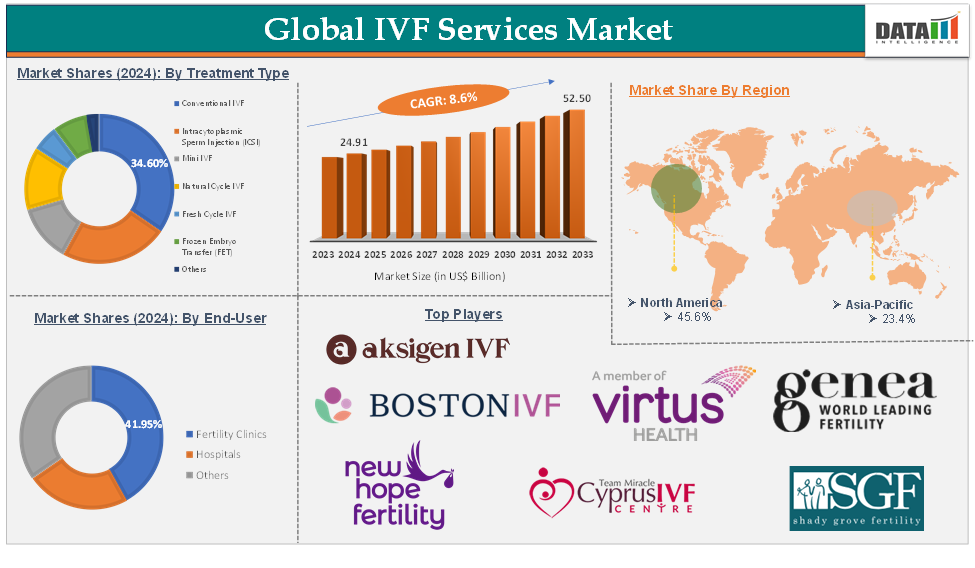
In Vitro Fertilization (IVF) Services Market is expected to reach at a CAGR of 8.6% during the forecast period 2025-2033.
The In Vitro Fertilization (IVF) Services Market is expanding as rising infertility, delayed parenthood, and advanced ART technologies drive global demand for successful assisted reproduction.”
AUSTIN, TX, UNITED STATES, January 14, 2026 /EINPresswire.com/ -- Market Overview:— DataM Intelligence
The In Vitro Fertilization (IVF) Services Market has emerged as one of the most dynamic segments within the global reproductive health and assisted reproductive technology (ART) industry. IVF services involve the fertilization of an egg with sperm outside the human body, followed by the transfer of the embryo into the uterus, offering hope to couples facing infertility, genetic disorders, or age-related reproductive challenges. Rising infertility rates, delayed parenthood, lifestyle-related health issues, and increasing awareness of fertility treatments are collectively driving strong demand for IVF procedures across both developed and developing economies. In addition, improvements in laboratory techniques, cryopreservation, preimplantation genetic testing, and embryo selection technologies are enhancing success rates, thereby increasing patient confidence and treatment uptake.
To Download Sample Report Here: https://www.datamintelligence.com/download-sample/in-vitro-fertilization-services-market
According to DataM Intelligence, The Global In Vitro Fertilization (IVF) Services Market was valued at approximately USD 24.91 billion in 2024 and is projected to reach around USD 52.50 billion by 2033, growing at a robust compound annual growth rate (CAGR) of nearly 8.6% during the forecast period. Growth is primarily fueled by the expanding population of women aged 30–45, rising prevalence of polycystic ovary syndrome (PCOS), endometriosis, male infertility, and the growing acceptance of assisted reproduction among single parents and same-sex couples. Among service types, fresh IVF cycles currently represent the leading segment due to their high clinical adoption and cost-effectiveness, while frozen embryo transfer (FET) cycles are rapidly gaining traction because of improved cryopreservation techniques. Geographically, North America dominates the IVF services market, driven by advanced healthcare infrastructure, high awareness levels, favorable reimbursement scenarios in select states, and the presence of leading fertility clinics and technology providers.
Key Highlights from the Report:
The Global IVF Services Market is witnessing steady growth due to rising infertility prevalence and delayed childbearing.
Technological advancements in embryo imaging, genetic screening, and cryopreservation are improving success rates.
Fresh IVF cycles remain the most widely adopted service type, while frozen cycles show the fastest growth.
Fertility clinics are the leading end users, supported by specialized infrastructure and skilled embryologists.
North America holds the largest market share, followed by Europe and Asia-Pacific.
Increasing medical tourism for fertility treatments is accelerating market expansion in emerging economies.
Market Segmentation Analysis:
The IVF Services Market is segmented based on service type, patient type, end user, and technology. By service type, the market includes fresh IVF cycles, frozen embryo transfer (FET), intracytoplasmic sperm injection (ICSI), donor egg IVF, and preimplantation genetic testing (PGT). Fresh IVF cycles currently dominate the market due to their established clinical protocols and relatively lower procedural complexity. However, frozen embryo transfer is gaining rapid momentum as vitrification techniques improve embryo survival rates and allow flexible treatment scheduling, reduced ovarian hyperstimulation risk, and higher cumulative pregnancy rates.
Based on patient type, the market is categorized into female infertility and male infertility. Female infertility accounts for a larger share owing to conditions such as PCOS, tubal blockage, endometriosis, and age-related ovarian decline. Nevertheless, male infertility is increasingly recognized, with ICSI becoming a standard procedure for cases involving low sperm count or poor motility. In terms of end users, fertility clinics dominate the IVF services market, followed by hospitals and research institutes. Dedicated fertility centers offer specialized laboratories, experienced reproductive endocrinologists, and advanced imaging systems, making them the preferred choice for patients seeking assisted reproduction.
Speak to Our Analyst and Get Customization in the report as per your requirements: https://www.datamintelligence.com/customize/in-vitro-fertilization-services-market
Regional Insights:
North America leads the global IVF services market, supported by high awareness of fertility treatments, advanced ART infrastructure, and strong investments in reproductive medicine research. The United States, in particular, benefits from the presence of large fertility clinic networks, favorable insurance coverage in certain states, and high acceptance of single-parent and same-sex family planning. Canada is also witnessing growing demand, driven by government-supported fertility programs and an increasing number of ART cycles performed annually.
Europe represents the second-largest regional market, with countries such as Spain, the United Kingdom, France, and Germany at the forefront. Europe’s leadership is strengthened by well-established regulatory frameworks, high clinical success rates, and cross-border reproductive care, especially in countries offering cost-effective and legally accessible treatments. Meanwhile, the Asia-Pacific region is projected to register the fastest growth rate during the forecast period. Rising disposable incomes, expanding medical tourism in India, Thailand, and Malaysia, and increasing social acceptance of assisted reproduction are making the region a major hub for IVF services. Latin America and the Middle East & Africa are also showing gradual growth, supported by improving healthcare infrastructure and rising awareness.
Market Dynamics:
Market Drivers
The primary driver of the IVF services market is the rising global infertility rate, attributed to delayed marriages, stress, obesity, smoking, environmental pollution, and sedentary lifestyles. The growing maternal age at first childbirth significantly increases the risk of reduced ovarian reserve, thereby boosting the demand for assisted reproductive technologies. Technological advancements, including time-lapse embryo imaging, AI-based embryo selection, and preimplantation genetic testing, are further enhancing treatment outcomes and patient confidence. In addition, expanding insurance coverage for fertility treatments in certain countries and increasing government support for reproductive health are contributing to market growth.
Market Restraints
Despite its growth potential, the IVF services market faces notable challenges, primarily related to high treatment costs and uneven reimbursement policies. A single IVF cycle can be financially burdensome, particularly in regions without insurance coverage or public funding, limiting access for middle- and low-income populations. Ethical and regulatory concerns surrounding embryo handling, genetic screening, and surrogacy also create barriers in certain countries. Furthermore, emotional stress, social stigma, and variable success rates may discourage some patients from pursuing treatment.
Market Opportunities
The market offers substantial opportunities through the expansion of fertility preservation services, such as egg and sperm freezing, particularly among career-focused individuals and cancer patients undergoing gonadotoxic therapies. Emerging economies present untapped potential due to large populations, increasing awareness, and growing healthcare investments. The integration of digital health platforms, teleconsultations, and personalized treatment protocols based on genetic and hormonal profiling is expected to further enhance patient experience and clinical efficiency, opening new growth avenues for IVF service providers.
Looking For Full Report? Get it Here: https://www.datamintelligence.com/buy-now-page?report=in-vitro-fertilization-services-market
Frequently Asked Questions (FAQs):
How Big is the Global In Vitro Fertilization (IVF) Services Market Today?
Who are the Key Players in the Global IVF Services Market?
What is the Projected Growth Rate of the In Vitro Fertilization Services Market?
What is the Market Forecast for the IVF Services Industry in 2032?
Which Region is Estimated to Dominate the IVF Services Market through the Forecast Period?
Company Insights:
Key players operating in the IVF Services Market include:
Virtus Health
Genea Pty Limited.
Aksigen
Shady Grove Fertility
New Hope Fertility Clinic
Boston IVF
Cyprus IVF Centre
EUVITRO S.L.U.
Fertility Centers of Illinois
Houston Fertility Center
Recent Developments:
United States:
December 2025: A landmark partnership between Illumina and U.S. fertility chains launched low-cost PGT-A testing nationwide, reducing prices by 30% and enabling over 50,000 additional cycles amid rising demand from delayed parenthood trends.
November 2025: President Trump's administration expanded federal insurance mandates for IVF under the Affordable Care Act revisions, covering up to 80% of costs for couples under 40, significantly increasing accessibility in states like California and New York.
October 2025: The U.S. FDA approved a novel embryo selection technology using AI-driven genetic screening, boosting IVF success rates by 15% in early trials at major clinics like Shady Grove Fertility. This innovation addressed longstanding challenges in embryo viability assessment.
Japan:
December 2025: Hokkaido University unveiled a breakthrough in mitochondrial replacement therapy for IVF, gaining JART approval and marking Japan's first domestically developed "three-parent" IVF method to combat hereditary disorders.
November 2025: Leading Tokyo fertility centers adopted advanced cryopreservation tech from Kitazato Corporation, improving frozen embryo survival to 98%, a key step in addressing Japan's infertility epidemic affecting 1 in 4.4 couples.
October 2025: Japan's Ministry of Health introduced subsidies covering 50% of IVF costs for women under 45, part of the national birth rate initiative, leading to a 20% surge in clinic enrollments in Tokyo and Osaka.
Unlock 360° Market Intelligence with DataM Subscription Services: https://www.datamintelligence.com/reports-subscription
Conclusion:
The In Vitro Fertilization (IVF) Services Market is positioned for sustained growth over the coming decade, driven by rising infertility rates, technological innovation, and evolving societal attitudes toward assisted reproduction. With continuous improvements in clinical outcomes, expanding fertility preservation options, and increasing accessibility in emerging economies, IVF services are becoming an integral component of modern reproductive healthcare. As investments in research, infrastructure, and personalized treatment solutions continue to rise, the market is expected to witness further expansion, offering renewed hope to millions of individuals and couples worldwide seeking to build families through advanced reproductive technologies.
Related Reports:
Sterilization Services Market
Thrombectomy Devices Market
Sai Kiran
DataM Intelligence 4Market Research
+1 877-441-4866
Sai.k@datamintelligence.com
Visit us on social media:
LinkedIn
X
Legal Disclaimer:
EIN Presswire provides this news content "as is" without warranty of any kind. We do not accept any responsibility or liability for the accuracy, content, images, videos, licenses, completeness, legality, or reliability of the information contained in this article. If you have any complaints or copyright issues related to this article, kindly contact the author above.
