

Your business and economy news reporter
Provided by AGP
New 30-Year U.S. National Entrepreneurship Research by Ewing Marion Kauffman Foundation Indicates Rise in New Businesses Since Covid-Era Drop; Identifies Opportunities to Boost Economic Growth
Landmark research data reveals new businesses remain the engine of growth, creating more than 3 million jobs per year
KANSAS CITY, Mo., May 19, 2026 (GLOBE NEWSWIRE) -- Since its inception, the Ewing Marion Kauffman Foundation has seen entrepreneurship as a pathway to wealth and a driver of equitable economic mobility. Today, it released findings from its 30-year study on entrepreneurship in the United States — the most comprehensive longitudinal analysis of its kind.
The Kauffman Indicators of Entrepreneurship¹ report delivers mixed news for the state of American entrepreneurship. The number of Americans starting new businesses has rebounded to pre-pandemic levels, demonstrating resilience and signaling renewed economic confidence. This recovery is fueled in large part by increasing numbers of immigrant, Latino, and Black businesses. At the same time, businesses starting out of necessity rather than by choice were on the rise in the last year, particularly among the same population of entrepreneurs helping to drive growth.
“For three decades, we have tracked the heartbeat of American entrepreneurship,” said Kauffman Foundation President and CEO DeAngela Burns-Wallace, Ed. D. “We aim to deepen our understanding of what works or doesn’t to ensure entrepreneurship thrives, not just survives. While recovery is promising, our goal is to accelerate and expand programs to ensure economic mobility for all.”
Start-ups continue to drive new job creation in the economy, but the number of jobs created by start-ups has stagnated and is well below rates seen in the first years of indicators data in the late 1990s.
“Entrepreneurship continues to gain strength coming out of the pandemic, yet many new businesses were started out of necessity last year, particularly in Black and brown communities,” said Joshua Akers, Ph.D., Director of Research at the Kauffman Foundation. “The number of entrepreneurs choosing to start a business remains well above pandemic lows, but entrepreneurs face significant economic headwinds and an uncertain policy terrain.”
Key findings from the 30-year study include:
Entrepreneurship rebounds: In 2025, roughly 6.6 million American adults started a new business or about 360 for every 100,000 working-age adults each month. Immigrants opened approximately 2.3 million businesses last year, double the rate of native-born Americans. Latino and Black Americans were also highly active, starting approximately 2 million and 1.1 million businesses respectively while white Americans, making up nearly 75% of the working-age population, started approximately 4 million businesses.
Businesses started out of necessity rose in 2025: Men and women both saw the number of businesses started from opportunity instead of necessity decline in 2025. All age groups experienced decline in opportunity share and all racial and ethnic groups experienced declines.
Start-ups, new jobs and survival: New start-ups continue to drive job growth in the economy creating 5.3 jobs per 1,000 people in 2025, but job creation numbers lag the highest seen in the late 1990s and those reached prior to the pandemic. Survival remains a tricky business for start-ups, with just over three-quarters of businesses surviving their first year in 2025. This rate is lower than the 2024 and pre-pandemic survival rates.
Immigrants drive growth: Immigrant entrepreneurs continue to lead new business creation, outpacing their share of all new entrepreneurs. Since the mid-1990s, people with Latino and Asian heritage, both U.S.-born and immigrants, have grown to represent 24.2% and 7.3% of new entrepreneurs, respectively—more than double where they started. Immigrants overall have seen comparable gains.
Gender gap persists: Many of the same barriers women face in building and establishing careers persist in the realm of entrepreneurship. Over 30 years, the gap between men and women pursuing entrepreneurship has remained nearly unchanged. The rate of entrepreneurship for men and women are both trending well above pre-pandemic levels, yet the gap between them widened slightly in 2025.
The data demonstrates that starting and sustaining a business in the United States remains difficult. Yet the pandemic appears to have produced a growing number of individuals willing to try whether out of necessity or seizing on opportunity. The work of the Kauffman Foundation is to ensure that there are adequate supports, responsive policy, and new paths that allow any entrepreneur to access the capital and resources they need to start and to sustain their business.
The Kauffman Foundation funds nonprofit organizations that support entrepreneurship and operates the 1 Million Cups and Kauffman FastTrac® programs to increase the number of entrepreneurs and their survival rate.
About the Kauffman Indicators of Entrepreneurship
The Kauffman Indicators of Entrepreneurship are a leading source of national and state-level data on new business creation and early-stage startup activity in the United States.
About the Ewing Marion Kauffman Foundation
Based in Kansas City, Missouri, the Ewing Marion Kauffman Foundation works through grantmaking, research, and programs to advance equitable economic mobility. Focused on college access and completion, workforce and career development, and entrepreneurship, the Foundation works to strengthen systems that enable people and communities to learn, work, and thrive. Learn more at Kauffman.org.
¹Fairlie, Robert (2026). National Report on Early-Stage Entrepreneurship in the United States: 2025, Kauffman Indicators of Entrepreneurship, Ewing Marion Kauffman Foundation: Kansas City.
Photos accompanying this announcement are available at:
https://www.globenewswire.com/NewsRoom/AttachmentNg/8f606f95-d319-4b90-9ee3-2f68a585d5f2
https://www.globenewswire.com/NewsRoom/AttachmentNg/58218007-d353-4c68-9493-7fc2ad822a51
https://www.globenewswire.com/NewsRoom/AttachmentNg/f415cd75-5b5e-4ed5-b9fb-76053390e642
https://www.globenewswire.com/NewsRoom/AttachmentNg/2575a3c0-67b4-4db2-b4c4-b209b05cb02e

Media Contact:
Ewing Marion Kauffman Foundation
Julie Scheidegger
jscheidegger@kauffman.org

Opportunity Share of New Entrepreneurs (1998-2025)

30-Year U.S. National Entrepreneurship Research by Ewing Marion Kauffman Foundation
Startup Early Job Creation (1996-2025)
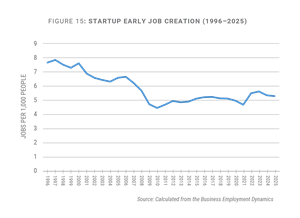
30-Year U.S. National Entrepreneurship Research by Ewing Marion Kauffman Foundation
Rate of New Entrepreneurs by Nativity (1996-2025)

30-Year U.S. National Entrepreneurship Research by Ewing Marion Kauffman Foundation
Rate of New Entrepreneurs by Education (1996-2025)

30-Year U.S. National Entrepreneurship Research by Ewing Marion Kauffman Foundation
Legal Disclaimer:
EIN Presswire provides this news content "as is" without warranty of any kind. We do not accept any responsibility or liability for the accuracy, content, images, videos, licenses, completeness, legality, or reliability of the information contained in this article. If you have any complaints or copyright issues related to this article, kindly contact the author above.
