

From oil to electrons: lessons from the 1970s energy crises
By Daniela Arlia and John Hutchinson
Europe’s electricity mix has become cleaner and less exposed to fossil fuel price swings. The challenge now is to extend electrification to transport, heating and industry. The lesson from the 1970s is that we must not just diversify energy supply but push for structural change too.
Europe is once again confronting the macroeconomic consequences of its dependence on imported energy. This is not a new challenge. Much of the history of inflation since the 1970s has been shaped by large swings in oil and, more recently, gas prices. But the enduring lesson from the 1970s is not only that energy shocks are economically damaging – we have also learned that major shocks can trigger lasting structural change when policy, investment and technology move in the same direction.[1]
Chart 1
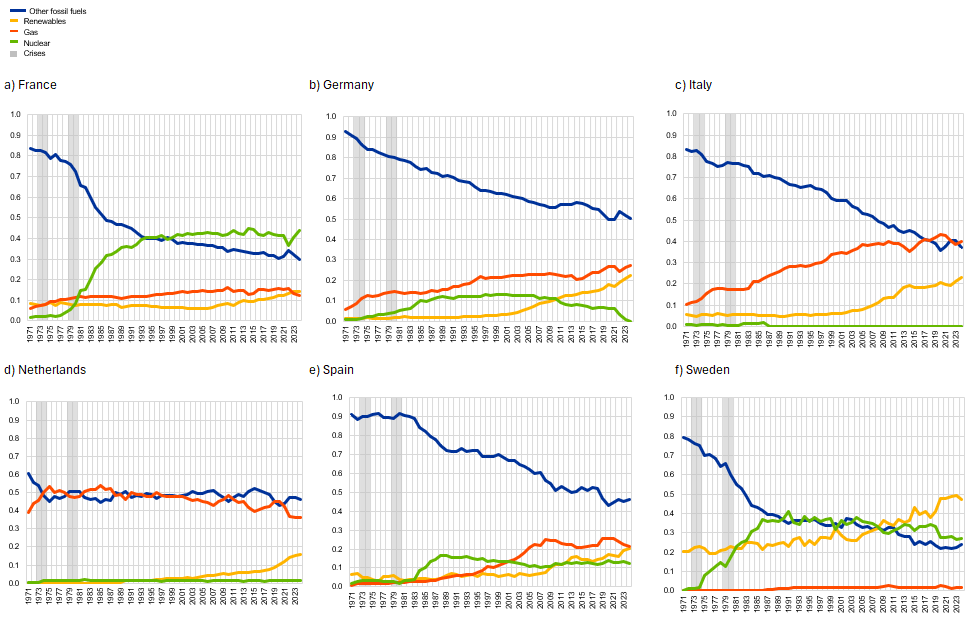
Historical trends in energy mix, 1971-2024
Sources: IEA and ECB calculations.
Notes: The chart shows the shares of total energy supply by product. Grey shaded areas correspond to periods of large oil shocks during the 1970s (1973-74 and 1979-80). Large oil shocks are defined as episodes involving a cumulative change in the (log) price of oil of above 50%, sustained for more than four quarters (see Blanchard and Galì, 2007).
Chart 1 shows how significantly the energy mix of Europe’s large economies changed after the 1970s oil shocks. The weight of coal and oil declined markedly over time in most countries, while nuclear energy gained ground in several. At the same time, the share of natural gas and, later, of renewables in total energy supply increased overall. That diversification mattered. It reduced the high exposure that existed when oil dominated the energy system.[2] But it also had notable limitations. While overall Europe’s economy became less dependent on oil and coal, fossil fuels remained deeply embedded in specific sectors such as transport, heating and large parts of industry.
Today differs from the 1970s in one decisive respect: many of the technologies needed to bring about structural change in our energy use now exist on a large scale and have become increasingly competitive. According to the International Renewable Energy Agency, 91% of new renewable power projects commissioned in 2024 were cheaper than fossil fuel-based alternatives. So going forward, it also makes good business sense to move away from fossil fuels.[3] That makes the present challenge different. Europe is not only trying to absorb another external energy shock – it also has a realistic opportunity to reduce future exposure to fossil fuel price volatility.
Chart 2
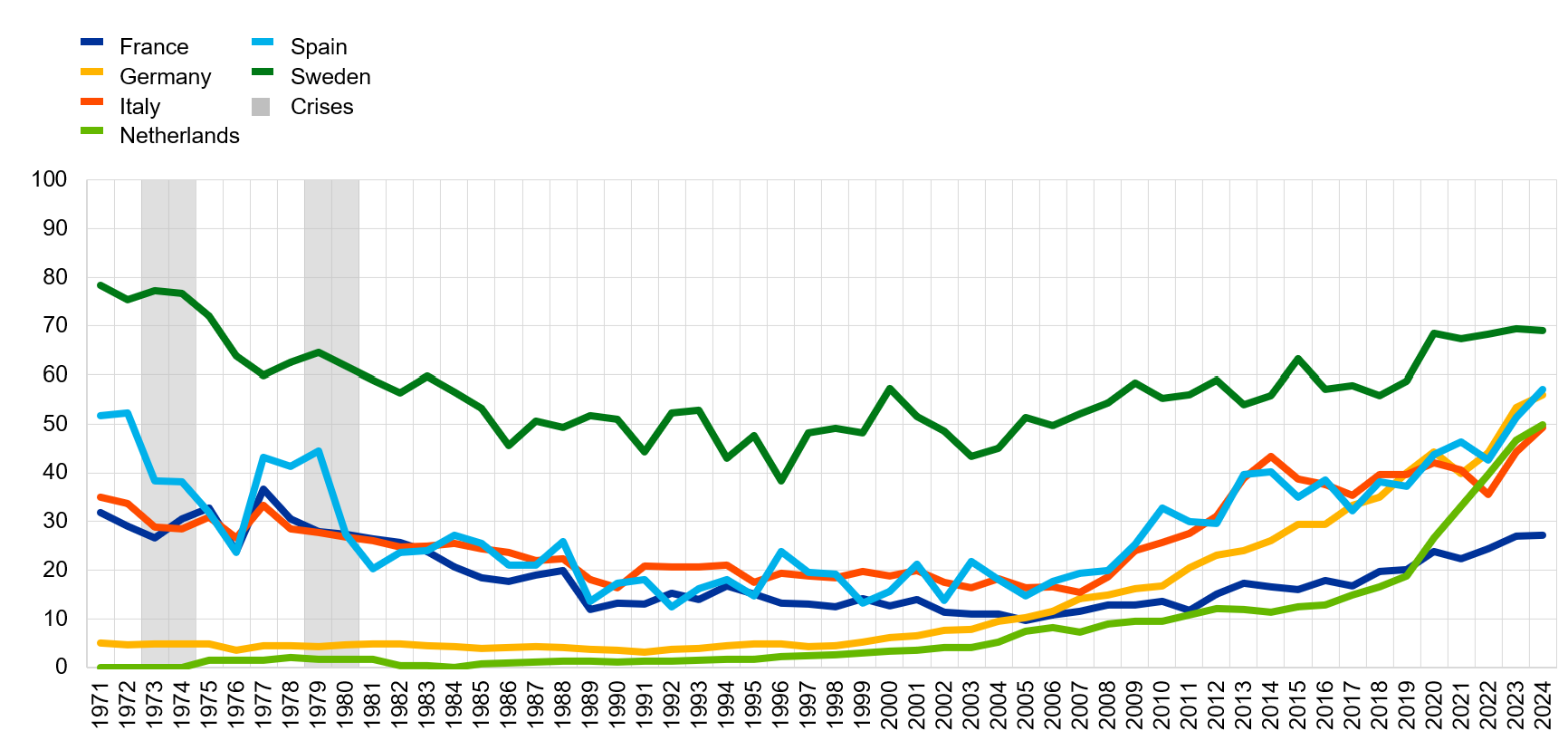
Share of renewables in total electricity production, 1971-2024
(Percentages)
Sources: IEA and ECB calculations.
Notes: Grey shaded areas correspond to periods of large oil shocks during the 1970s (1973-74 and 1979-80). Large oil shocks are defined as episodes involving a cumulative change in the (log) price of oil of above 50%, sustained for more than four quarters (see Blanchard and Galì, 2007).
The most visible progress has been in electricity generation, where renewable technologies have expanded rapidly. Chart 2 shows how the share of renewables in electricity generation has increased more quickly in recent years compared with the overall energy mix. In 2024 renewables generated a record 47% of total EU electricity.[4] In some countries, their share exceeded 50% (see Chart 2). This is a remarkable change compared with the structure of the system even a decade ago, with the electricity mix becoming less directly exposed to fossil fuel price swings.[5]
Yet a cleaner power mix and a more resilient overall energy system are not the same thing. Europe has progressed much faster in changing how electricity is produced than in changing how energy is used. In other words, there is considerable scope for further electrification of the economy. This matters for reducing emissions. Additionally, macroeconomic gains from cheaper and cleaner electricity remain partial if households still heat with fossil fuels and if transport and industrial processes still run mainly on oil and gas. Cleaner generation lowers one channel of exposure, but it does not eliminate the others.
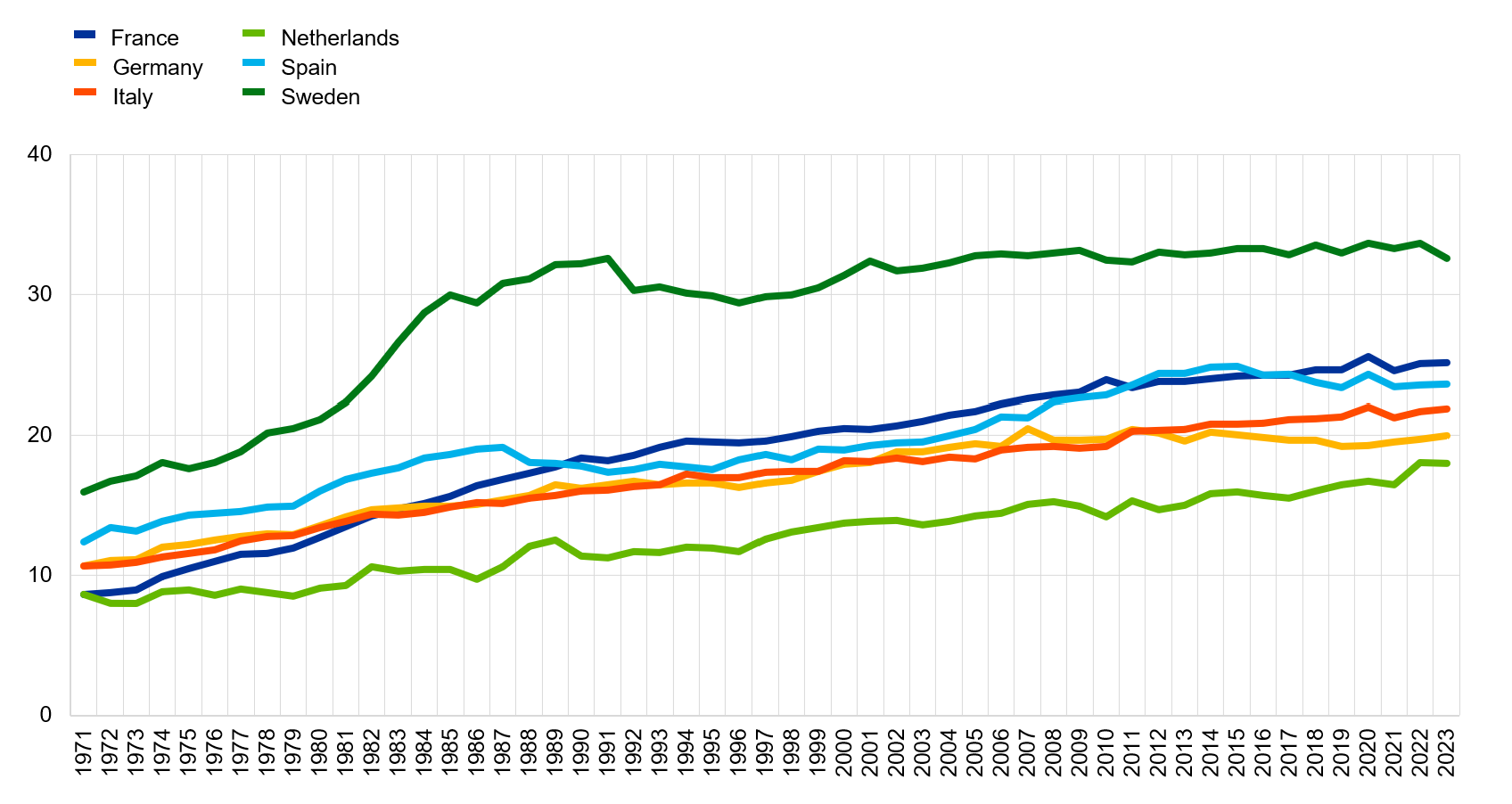
This is where the current debate sometimes loses focus. Diversifying electricity generation is necessary, but it is not sufficient. The next stage of transition depends on the electrification of final energy consumption to an indicative target of 46% by 2040.[6] Chart 3 shows that electricity still accounts for only around 23% of Europe’s final energy use and has been broadly unchanged over the last decade. As long as that share remains relatively low, the euro area will continue to import a large amount of exposure to volatile oil and gas markets through the sectors where electrification has moved slowly. For instance, the EU spent €336.7 billion on imported energy products in 2025 and has spent an extra €27 billion on fossil fuel imports since the war in Iran started.[7]
Chart 3
Share of electricity in total energy consumption, 1971-2023
(Percentages)
Sources: IEA and ECB calculations.
All of this matters to central banks, because the structure of the energy system affects the inflation process. And it is the job of central banks to stabilise and keep inflation at bay through monetary policy. Of course, monetary policy cannot substitute energy policy. But the euro area is particularly exposed to energy-import shocks and large disturbances can make inflation more persistent by changing how quickly firms and workers adjust prices and wages.[8] The less dependent the economy is on volatile imported fossil fuels, the less frequently monetary policy will be confronted with this kind of supply shock.
The broader policy lesson from the 1970s is therefore not simply that Europe should diversify. It is that crises can create the conditions for structural transformation. But that is only the case if the response goes beyond short-term relief. In the 1970s, that meant new institutions, strategic reserves, nuclear expansion and efficiency gains.[9] Today, the equivalent would be increased electrification by firms and households, which requires deeper grid investment, more storage and stronger interconnection.[10]
If the 1970s marked the beginning of diversification away from oil, this decade could become the turning point when Europe moves more decisively from fossil fuels to electrons.
The views expressed in each blog entry are those of the author(s) and do not necessarily represent the views of the European Central Bank and the Eurosystem.
Check out The ECB Blog and subscribe for future posts.
For topics relating to banking supervision, why not have a look at The Supervision Blog?
Alpanda, S. and Peralta-Alva, A. (2010), “Oil crisis, energy-saving technological change and the stock market crash of 1973-74”, Review of Economic Dynamics, 13(4), pp. 824-842.
Arce, Ó., Battistini, N., Bouabdallah, O. and Lis, E. (2026), “A tale of two energy crises – Initial conditions matter”, The ECB Blog, ECB.
Arlia, D., and Hutchinson, J. (2026), “Drivers of electricity prices across households and energy-intensive industries and their importance for the EU’s decarbonisation objectives”, Economic Bulletin, Issue 1, ECB.
Blanchard, O. J. and Gali, J. (2007), “The Macroeconomic Effects of Oil Shocks: Why are the 2000s so different from the 1970s?”, NBER Working Paper, No 13368.
Grynberg, C., Vinci, F. and De Sanctis, A. (2026), “Energy security and industrial competitiveness: the case for a European Energy Union”, Occasional Paper Series, No 388, ECB.
International Energy Agency (2025), “World Energy Outlook 2025”, Paris.
International Energy Agency (2025), “Renewables 2025”, Paris.
Lagarde, C. (2026), “Navigating energy shocks: risks and policy responses”, keynote speech at “The ECB and Its Watchers” Conference, 25 March.
Lane, P.R. (2026), “Climate change and monetary policy”, keynote speech at the Climate, Nature and Monetary Policy Conference jointly organised by the ECB, the Centre for Economic Transition Expertise and the Frankfurt School of Finance and Management, Frankfurt am Main, 5 May.
McKibben, B. (2025), Here comes the sun: A last chance for the climate and a fresh chance for civilization, WW Norton & Company.
Navia Simon, D. and Diaz Anadon, L. (2025), “Power price stability and the insurance value of renewable technologies”, Nat Energy 10, pp. 329-341.
Parker, M. and Parraga Rodriguez, S. (2026), “Overcoming structural barriers to the green transition”, Economic Bulletin, Issue 1, ECB.
Roth, A., Tagliapietra, S. and Zachmann, G. (2026), “Better coordination for a more efficient European energy system”, Policy Brief 02/2026, Bruegel.
Von der Leyen, U. (2026), “Speech at the European Parliament plenary debate on the EU strategy in response to the ongoing Middle East crisis, its implications on energy prices and the availability of fertilisers”, 29 April.
Legal Disclaimer:
EIN Presswire provides this news content "as is" without warranty of any kind. We do not accept any responsibility or liability for the accuracy, content, images, videos, licenses, completeness, legality, or reliability of the information contained in this article. If you have any complaints or copyright issues related to this article, kindly contact the author above.
